Them
A short horror story inspired by my grandmother, mental health, and family.

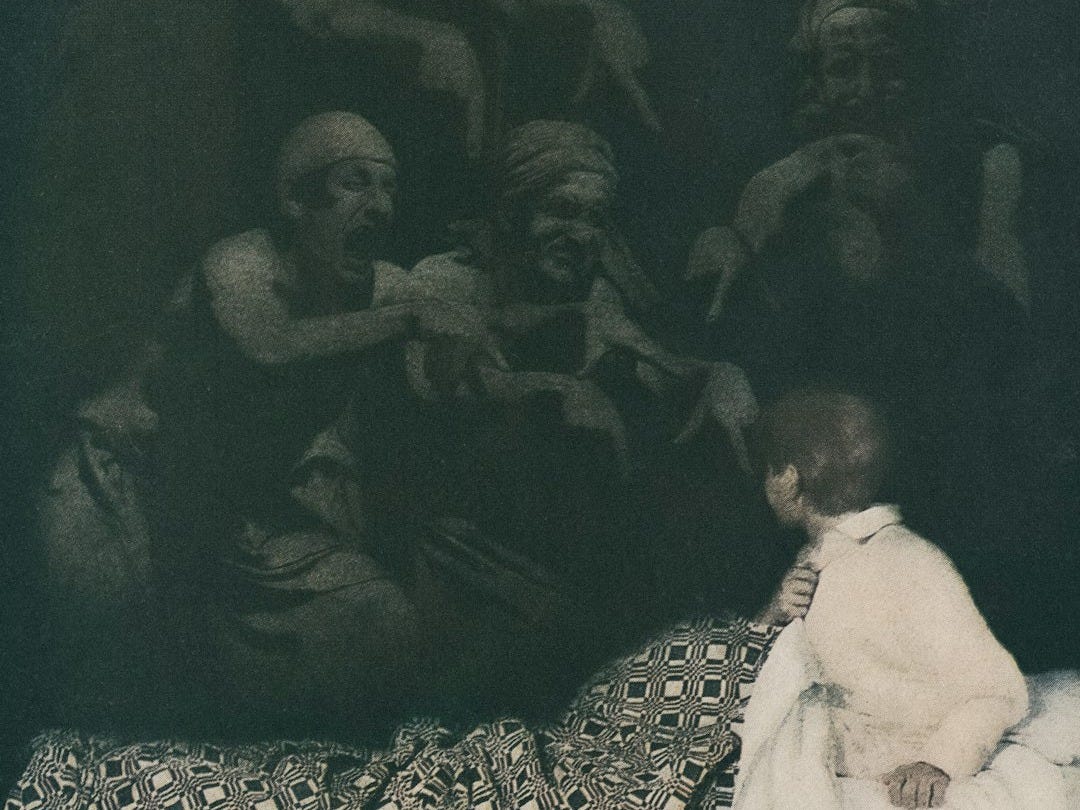
I didn’t believe my mother when she told my little brother and me that little people were watching us—specifically, tiny, inky-black figures with beady red eyes.
He and I sat in front of our black-and-white television set when she crept in beside us, still wearing her bathrobe, her breath reeking of alcohol, and asked if we saw them.
We shared a concerned look. I chose to answer her.
“No, Mama. There’s nobody there.”
A week later, she came to me while my brother played outside. This time, she didn’t smell of booze. In fact, I hadn’t seen her take a drink in several days.
She leaned close enough for me to smell her breath. There wasn’t a trace of alcohol.
“Jimmy, they’re here now,” she whispered. “Do you see them?”
I glanced around the kitchen and shrugged. “Nothing.”
She nodded. Her eyes fell for a brief moment before she turned away and headed back to her room.
Almost a year later, Mama shook us awake. My brother and I shared a bed because it was all we could afford.
“Jimmy. Larry. Wake up.”
We opened our eyes, and we could tell she hadn’t been sleeping.
“We have to go,” she told us. “They’re here, and they said they aren’t leaving.”
We followed her through the house, leaving all our belongings behind because she believed taking anything would only bring them along to our new home.
Our new home was an old studio apartment above a butcher’s shop. It smelled of old blood and rotting meat.
By the time I finished high school, all I could think about was Larry. I couldn’t leave him alone with her.
Our mother had spiraled out of control. She never let us leave her sight unless we were going to school. She covered every window with aluminum foil, claiming it would keep them out, and constantly chatted about the little demons and their diabolical plans.
I feared she would hurt my little brother, so I stayed.
I attended a local community college while working part-time at a diner, waiting for the day Larry graduated so we could find a place and move in together away from our mother.
One day, I came home after work to find police cars and an ambulance surrounding our house. I feared for Larry, but then I saw him standing beside a parked police vehicle, unharmed, while Mama was rolled toward the ambulance on a stretcher.
Strapped down, she thrashed her head from side to side. The look in her eyes was unnatural.
She kept screaming that it was too late. They had invaded. They had gotten everywhere. She couldn’t stop them. None of us could.
Her screams echoed through the neighborhood as she tried to warn us all.
A chill went down my spine when I noticed the way she stared from the corners of her eyes, as though she were searching for them.
At Larry’s behest, I took him to visit her at the loony bin every week. The doctors diagnosed her with paranoid schizophrenia and placed her on several medications meant to sedate and calm her. Conversation was kept to a minimum, but Mama and Larry played card games together, and that was enough to make him happy.
A year later, I received a telephone call from one of her doctors.
“I’m afraid your mother died last night,” he told me. “She choked during an episode.”
“How? Isn’t she restrained at night?”
“Yes. Despite remaining calm and lucid for several months, she began seeing the little creatures again. We couldn’t administer enough tranquilizer to calm her. During the struggle, she bit down on her tongue and choked on the blood.”
Although I knew Larry would be devastated, for the first time in my life, I felt relieved.
She had given me life, and I knew she loved us, but I was tired of having a burden for a mother.
Unfortunately, it wouldn’t be the last we heard of them.
After high school, Larry went off to college in another state. I remained in our hometown after graduating, and I started working as a salesman for a local automotive dealership. I bought a home and started dating a coworker named Dottie after we hit it off at the company picnic.
I promised Larry he would always have a home to return to during school breaks and after graduation while he got on his feet.
Every Sunday before dinner, he’d call to tell me about his week. When he couldn’t call, he usually sent a letter explaining that he had a lot on his plate but that everything was all right.
For several weeks, neither came.
I hadn’t heard a word from him, and Christmas break was approaching. We usually discussed our plans ahead of time—whether I would pick him up at the bus station or he would hitch a ride with a friend passing through town.
Since things were becoming serious between Dottie and me, I assumed Larry was also becoming more independent and relying less on our weekly conversations.
Still, I worried.
I called the university and asked to speak with him.
“Sir, he dropped out two months ago,” someone in the registrar’s office told me.
A cold sweat spread across my body as I tried to imagine what had happened.
A week later, after countless conversations with the police, they found his body.
According to the investigation, he had begun exhibiting erratic behavior before leaving the university. Once the papers for his withdrawal were signed, he walked out into the blistering cold, crossed town, and disappeared into the wilderness, where he froze to death.
His belongings arrived by delivery. The university had packed everything into his leather footlocker and included a letter of condolence.
My fiancée, Dottie, left me alone to go through his things. She offered to help arrange everything in the guest bedroom, which would have been his after graduation.
He had kept very little: a few changes of clothes, an old tattered blanket our maternal grandmother had made for the bed we shared as children, several photographs of us growing up, and a little black book he had used as a diary.
Fear crept through me as my fingers traced its faux-leather binding.
Memories of our mother’s rants rushed to the forefront of my mind as I opened to the first page.
I see them now.
Dear God. I thought she was crazy, but I see them.
Why now?
Why me?
They’re tiny, with little black bodies, glaring red eyes, and sharp-toothed grins. I only see them out of the corners of my eyes—staring at me, whispering, moving things.
At first, it was childish pranks. A pencil moved here. A pen disappeared there. Ink spilled across my typed reports.
Now, bigger things are happening.
Anyone I spend time with gets hurt. My buddy Dane fell down a flight of stairs and ruined his throwing arm. He lost his scholarship and had to leave school.
My girl, Nancy, woke up choking after a bolt fell from the ceiling and landed in her open mouth while she slept.
Rumors started that I caused both incidents, even though Dane and Nancy denied I had anything to do with them. Mama’s history of mental illness lingers in the minds of the faculty, and now the rumors have spread through the student body.
My homework disappears, and I’m failing my classes. My food vanishes. I can’t shower without slipping and falling, the water suddenly shutting off, or the temperature becoming so hot that it burns me. I wake up with new bruises and sores.
I am alone.
I am scared.
God, is this how Mama lived? Did they torment her because she could see them? How much did she keep from us?
I wonder if Jimmy will believe me or think I’m crazy.
I think I’m crazy.
BUT. THEY. ARE. REAL.
I sat with my mouth hanging open in shock.
As I skimmed through the remaining pages, I watched my little brother lose his mind, though he fought desperately to remain as sane as possible. He had drawn several pictures of the little people. They looked like miniature gremlins from an old cartoon.
But those red eyes.
Despite the simplicity of the drawings, I could see the malice in them.
Dottie saw the pain and fear on my face. I had lost both my mother and my brother to a disease they couldn’t fight, and I worried I would pass it on to my own children.
She understood. Together, we changed our plans and decided to adopt rather than conceive naturally.
I visited therapists and psychologists for annual checkups. I thought that if we caught the illness early enough, perhaps I could survive it.
No symptoms ever appeared.
Dottie passed away a year ago from an aneurysm. She lived to be seventy-four.
God, I miss her.
After she died, I asked my son and daughter—named Larry and Marie after my brother and mother—to place me in a nursing home. I had grown tired of worrying about being alone.
I can feel the day approaching. I’m going to pass soon. My heart isn’t as strong as it used to be, and I have to fight too hard for every breath.
Every morning, as my therapists once instructed me, I wake up and check the corners of my eyes.
Nothing is ever there.
Each time, I release a heavy breath of relief.
Of everyone in my family, I am the only one who escaped the curse.
Larry and Marie bring their families to visit often, as I have been very forthright with them about my declining health. I love watching my grandchildren and great-grandchildren grow.
Today, my nine-year-old great-grandson, Jimmy Jr., came up to me and asked:
“Papa, what are those little black things in the corners of my eyes?”
-Jonnie